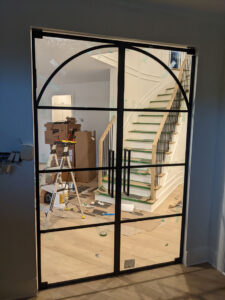
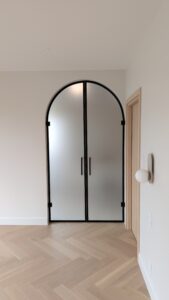
Glass arches are becoming increasingly popular in interior design. Whether for a shower, a partition, or a glass door, an arch adds a softer and more architectural feel to a space. However, what many people don’t realize is that there are two very different ways to achieve this look, with major differences in complexity, constraints, and budget. Understanding this difference is essential before starting a project.
Two Ways to Create a Glass Arch
1. True Arched Glass Door (Custom Glass)
A true arch means the glass itself is shaped into an arch. This type of project requires precise measurements using a physical template, custom-cut glass following the exact curve, specialized hinges adapted to the shape, custom metal work for the arch or frame, and paint finishing to match the rest of the project. To allow the door to open properly, a small gap of approximately 1/2 inch must be left between the top of the glass and the frame. This detail often surprises clients, but it is necessary for proper function. These projects require a high level of precision and coordination.
2. Rectangular Glass with Arched Metal (Flat Bar Design)
The second option uses a standard rectangular glass panel, with an arch created visually using custom metal. In this case, the glass remains rectangular, the arch is formed with metal, the metal is custom-made and painted, and it is typically installed on both sides of the glass. This approach creates a similar visual effect while being much simpler to execute.
Budget Differences
The two options are not equivalent in terms of cost. A true arched glass door involves more fabrication, precision, and specialized hardware, making it a higher-end solution. A flat bar arch design is more accessible, as it relies on standard glass with added visual detailing. The choice depends on the desired result, level of detail, and budget.
What Clients Often Don’t Expect
Several important details are not always visible in photos, such as the clearance required for the door to open, the precision needed for alignment, the coordination between glass, metal, and finishes, and the use of specialized hardware. Understanding these elements helps avoid surprises during installation.
Which Option Should You Choose?
A true arched glass door is ideal when the project is design-focused, architectural details are a priority, and the client is comfortable with technical constraints. A flat bar arch design is often preferred when the goal is to achieve the look without added complexity, when the budget is more controlled, and when the installation needs to remain straightforward.
Conclusion
Glass arches add character to a space, but the way they are built makes a significant difference. Some projects are more complex, others more accessible, but both can deliver excellent results when properly designed. The key is choosing the right approach based on the space, the desired style, and the project constraints.
To get a quote